It usually starts in the bar afterwards. Someone asks how the match went, and a sheepish grin gives the game away: “Lost seven and six.” A knowing nod goes round the table. “Ah, handed him a dog licence, then.”
To anyone under a certain age, the phrase is a complete mystery. To everyone else it’s one of golf’s most enduring little jokes, and the answer lies in a piece of British history that vanished over fifty years ago.
First, what does “7&6” even mean?
Match play isn’t about your total score. It’s a hole-by-hole scrap. Win more holes than your opponent and you go “up”; the match is over the moment your lead is bigger than the number of holes left. Results are written as holes up & holes to play.
So “7&6” means you were seven holes up with six to play. Even if your opponent won every remaining hole they couldn’t catch you, so hands are shaken there and then, on the 12th green, a full six holes early. It’s a proper drubbing.
So why a “dog licence”?
Here’s the punchline. For most of the twentieth century, owning a dog in Britain meant buying an annual dog licence, and it cost seven shillings and sixpence. Written down in the money of the day, that was “7/6”.
Seven and six. The same numbers as a thumping match-play defeat. So to lose 7&6 was to be “beaten by a dog licence”, and the nickname stuck fast.
The price was no accident of memory, either. The fee was fixed at seven shillings and sixpence by the Customs and Inland Revenue Act of 1878 and, remarkably, never changed. When Britain switched to decimal money it became 37½p, trimmed to 37p in 1984 when the halfpenny was scrapped, and the licence was finally abolished in 1987 (it had long cost more to collect than it raised). For 109 years, a dog licence cost exactly 7/6.
A quick word on old money (£sd)
If “seven shillings and sixpence” already sounds like a foreign language, you’re not alone. Before Decimal Day (Monday 15 February 1971), Britain ran on a system of pounds, shillings and pence known as £sd (from the Latin librae, solidi, denarii). It went like this:
- 12 pence (12d) made one shilling
- 20 shillings made one pound (£1)
- which means a tidy 240 pence to the pound, with no tens or hundreds in sight
And the coins themselves had wonderful names. Here’s a quick field guide to the ones you’d have jingling in your pocket:
| Coin | Value | Also known as |
|---|---|---|
| Farthing | ¼d | a quarter of a penny |
| Halfpenny | ½d | a “ha’penny” |
| Penny | 1d | a “copper” |
| Threepence | 3d | a “thruppenny bit” |
| Sixpence | 6d | a “tanner” |
| Shilling | 1/- (12d) | a “bob” |
| Florin | 2/- (two shillings) | an early decimal experiment, a tenth of £1 |
| Half crown | 2/6 (30d) | half a crown |
| Crown | 5/- (five shillings) | mostly a commemorative coin |
| Guinea | 21 shillings | for luxuries, professional fees & the racecourse |
And here’s what they actually looked like:
Tap any coin for a closer look.
Which puts our dog licence neatly in its place: 7/6 was exactly three half-crowns, comfortably more than a crown but a long way short of a guinea, and around three-eighths of a pound all told. Not a fortune, but not nothing. Roughly, then, the going rate for a thorough thrashing on the golf course.
The real reason this story matters
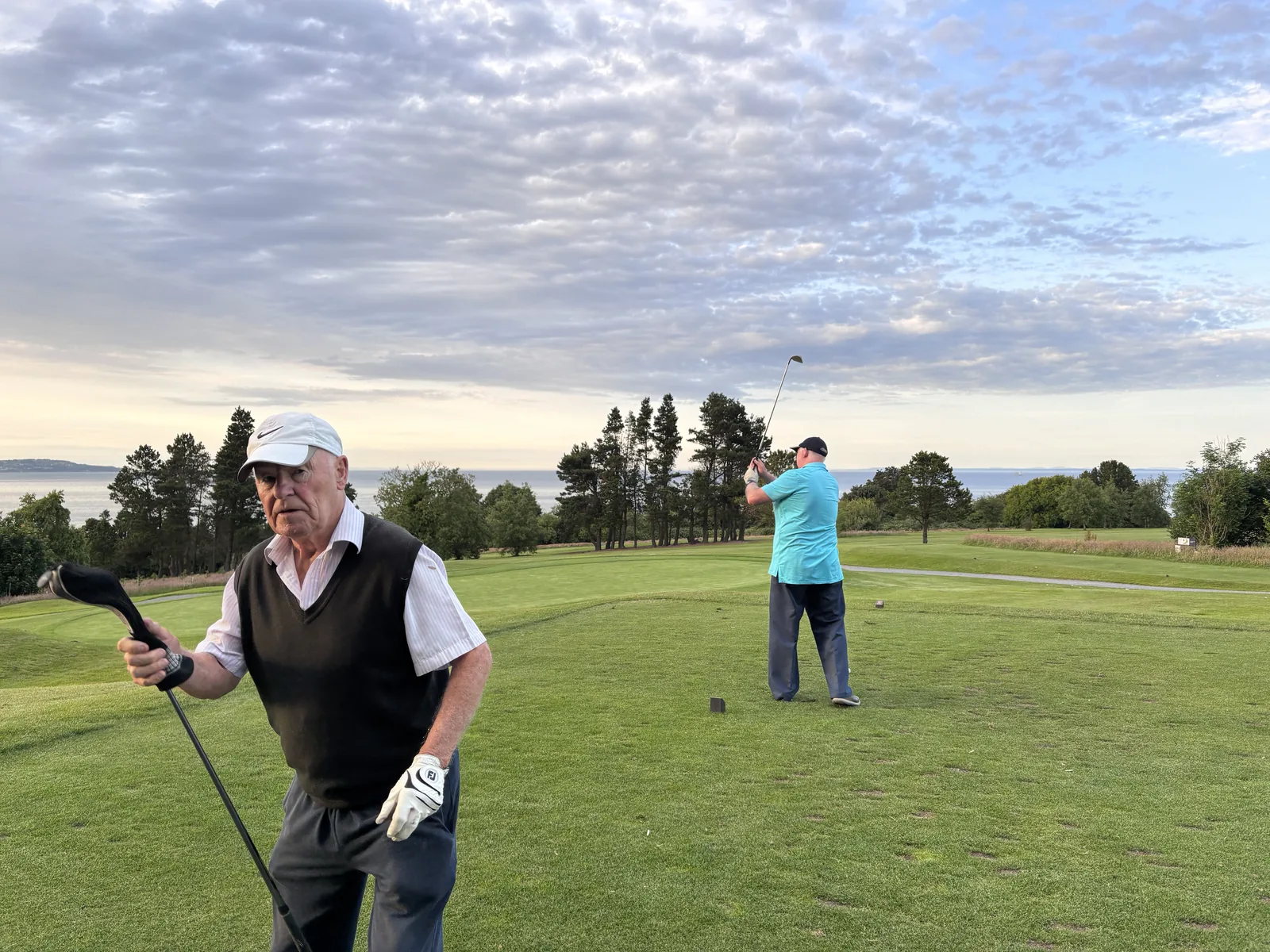
Here’s the lovely part. Nobody learns what a dog licence is from a textbook. You learn it the way we did: standing on a tee, getting gently ribbed by a playing partner twice your age who remembers buying one.
Golf is one of the very few games where a teenager and an eighty-year-old can tee it up in the same fourball, off handicaps that make it a real contest, and spend four hours in each other’s company. The handicap system levels the score; the walk does the rest. Along the way you pick up the slang, the history, the etiquette and a hundred small stories you’ll repeat for the rest of your life.
One of our members did exactly that not long ago. He came in off the course with a fistful of old coins, spread them across a clubhouse table, and walked a few baffled younger players through the whole £sd puzzle. To anyone raised on decimal money, the permutations were faintly mind-blowing. Then he pressed an old penny into a few hands, for luck. That penny is worth a sliver of a decimal pence today, but try telling that to anyone who was handed one.
So next time you’re drawn with the older members, listen in. You might lose 7&6, but you’ll come off the course a good deal richer than a dog licence.
Coin images courtesy of Wikimedia Commons (public domain), with the gold guinea from The Metropolitan Museum of Art (CC0).