Stableford is the most popular format in society and club golf, and for good reason. One terrible hole does not wreck your round, slow players can pick up and move on, and everyone from a 2 handicap to a 28 handicap can compete on the same leaderboard.
Here is exactly how it works, with a points table, worked examples and a free calculator.
How Stableford scoring works
Instead of counting every stroke, Stableford awards points on each hole based on your score relative to par, after your handicap strokes are applied. The highest points total wins.
The Stableford points table
| Your net score on the hole | Points |
|---|---|
| Albatross (3 under par) | 5 |
| Eagle (2 under par) | 4 |
| Birdie (1 under par) | 3 |
| Par | 2 |
| Bogey (1 over par) | 1 |
| Double bogey or worse | 0 |
The key word is net. Your handicap gives you extra strokes on certain holes, and points are calculated after those strokes are taken off.
Where do handicap strokes apply?
Every hole on a course has a Stroke Index (SI) from 1 to 18, printed on the scorecard. SI 1 is rated the hardest hole, SI 18 the easiest.
- If your handicap is 18, you get one stroke on every hole.
- If your handicap is 10, you get one stroke on the holes with SI 1 through 10.
- If your handicap is 24, you get one stroke on every hole, plus a second stroke on SI 1 through 6.
Why some scorecards have two stroke indexes
Here is a detail worth looking out for next time you play somewhere new. At some clubs, Cottrell Park in Wales is one, the scorecard carries two SI columns: the standard SI for strokeplay and Stableford, and a separate column just for match play, printed on the card as MSI, the match stroke index.
There is a good reason for it. The regular stroke index tends to rank holes purely by difficulty, and on plenty of courses the toughest holes come late in the round. That is fine in Stableford, where every hole counts no matter what. In match play it causes a familiar problem: if the SI 1 and SI 2 holes sit at the 16th and 17th, a match can be shaken hands on the 14th green before the higher handicapper ever received the shots that were supposed to level things up. If you have ever heard someone in the clubhouse complain that "the match was over before I got half my shots", this is why.
A match play stroke index fixes it by spreading the low index numbers earlier and more evenly across both nines, so shots arrive while the match is still alive. The Cottrell Park card does this with pleasing precision: the match index gives one nine all the odd numbers and the other nine all the evens, so however short the match, the shots keep coming. If your course only prints one SI, that is completely normal, but it is something for society organisers to keep in mind when running singles or fourball match play: a course's regular SI can quietly favour the lower handicapper.
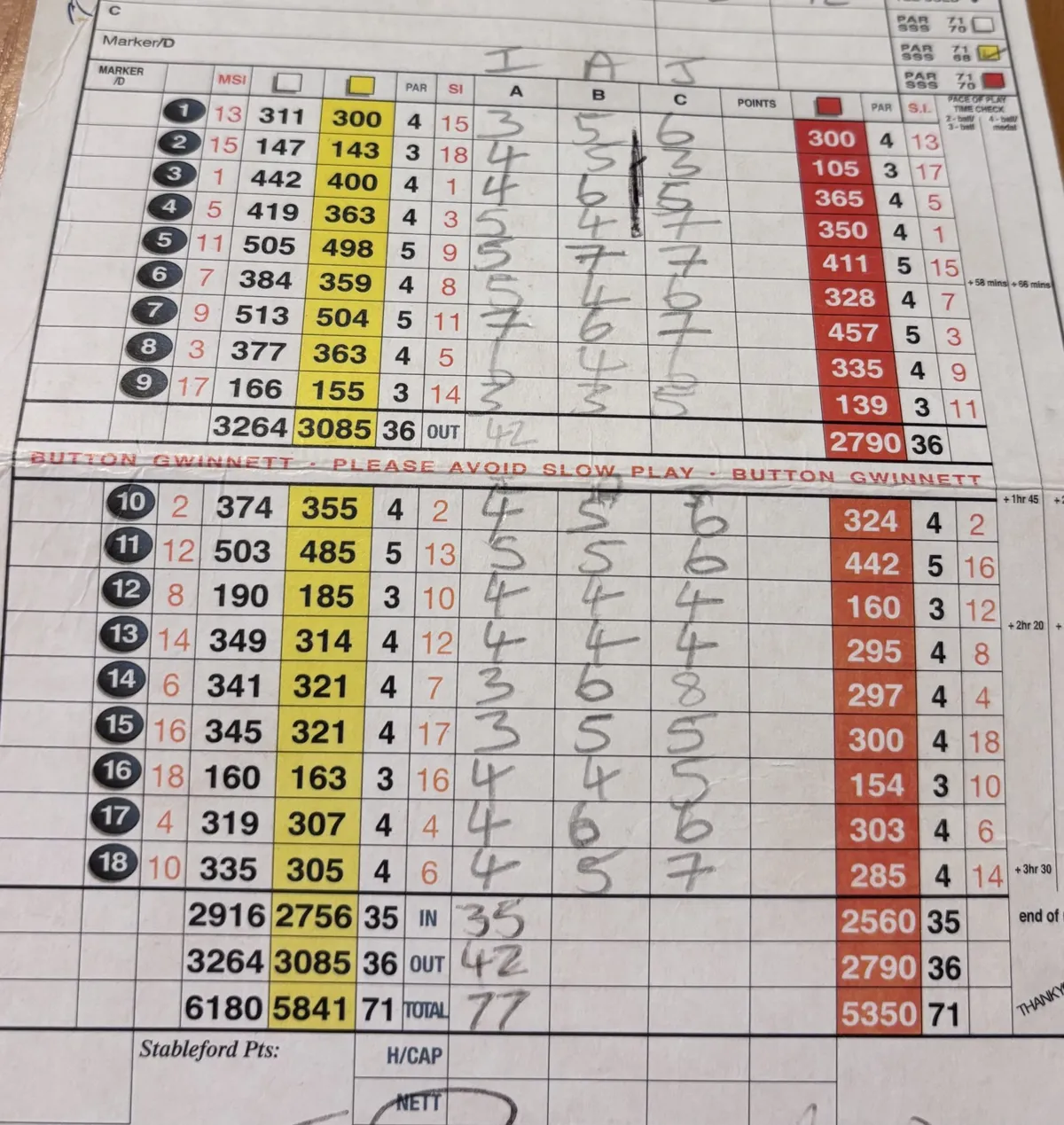
There is a pleasing bit of geography here too. Cottrell Park sits just up the road from Penarth, where Dr Stableford first trialled his points system at the Glamorganshire Golf Club in 1898, in the days before stroke indexes existed at all. A club a few miles away now printing two of them feels right. South Wales has form for scoring innovation.
A worked example
Sarah plays off 18, so she gets one stroke on every hole.
Hole 5, par 4, SI 8. Sarah takes 5 shots. Her net score is 5 minus 1 = 4, a net par. 2 points.
Hole 6, par 3, SI 16. Sarah takes 3 shots. Net 2, a net birdie. 3 points.
Hole 7, par 5, SI 2. Disaster. Sarah takes 9. Net 8, well over double bogey. 0 points. She could have picked up after her seventh shot, because once you cannot score a point the hole is over. This is why Stableford rounds are faster.
Hole 8, par 4, SI 12. Sarah takes 6. Net 5, a net bogey. 1 point.
Four holes, 6 points, and the nightmare on hole 7 cost her no more than a routine double bogey would have. In strokeplay that 9 would have haunted her whole card.
What is a good Stableford score?
36 points is the benchmark. It means you played to your handicap, averaging a net par on every hole.
- Under 30: a rough day, happens to everyone
- 30 to 35: slightly under handicap, a normal round
- 36: played exactly to your handicap
- 37 to 40: a very good round, probably in the prizes at a society day
- 41 or more: exceptional, expect a conversation with the handicap secretary
Most society outings are won with somewhere between 36 and 40 points, depending on course difficulty and weather.
Stableford calculator
Enter your handicap, the hole's par and stroke index, and your score. This runs the exact same scoring engine as a live PazGolf scorecard.
Want this done for you during the round? PazGolf scorecards calculate Stableford points live as every player in your group enters scores, with a leaderboard the whole society can watch.
Why societies love Stableford
- Nobody's round dies on one hole. A blob (zero points) hurts, but it is capped.
- Pick up and move on. Once a point is impossible, the hole is finished. Pace of play improves noticeably.
- All handicaps compete together. Net scoring on every hole means the 24 handicapper and the 6 handicapper are on level terms.
- Easy to run as an organiser. One leaderboard, one number per player, simple countback on ties.
If you run a society, see what PazGolf includes for societies: formats, handicaps and competitions, all handled.
Stableford variations worth knowing
Modified Stableford changes the points values to reward aggression, famously used at the PGA Tour's Barracuda Championship, with higher rewards for birdies and eagles and negative points for bogeys. Rare in society golf but fun for a change.
Maximum Score is a close cousin: normal strokeplay, but your score on any hole is capped, usually at net double bogey. Some societies prefer it because the final number still looks like a normal score.
Frequently asked questions
Do you count total strokes in Stableford?
No. Only points count. Two players can take very different numbers of strokes and finish on the same points.
What happens if I can no longer score a point on a hole?
Pick up your ball, write down a zero for the hole (often called a blob) and move on. It is not just allowed, it is encouraged for pace of play.
How are ties decided in Stableford?
Usually on countback: best points over the back nine, then the last six holes, then the last three, then the last hole. Your society rules should state the countback method in advance.
Is 36 points the same as playing to your handicap?
Yes. 36 points equals net par for the round, which is exactly what your handicap says you should shoot.
Who invented Stableford scoring?
Dr Frank Barney Gorton Stableford, a British doctor who devised the system to stop golfers giving up after a bad start. He first trialled a prototype on fellow members at the Glamorganshire Golf Club in Penarth, Wales, on 30 September 1898, before stroke indexes even existed, and the refined system made its official competition debut at Wallasey in England in 1932. The two clubs share the credit these days: conceived at one, perfected at the other, and golfers have been thanking him at both ever since.
Scoring a society day?
PazGolf scores Stableford, medal, matchplay, scrambles and more, live from any phone with no app download. See what is included for societies or try a live scorecard now.
Heading over from the States? Read our UK and Ireland guide for American golfers.